



.webp)
.webp)
.webp)
.webp)


.webp)
.webp)


.webp)
.webp)

.webp)
.webp)
.webp)
.webp)

.webp)
.webp)
.webp)
.webp)




Preparations are underway on 9 April 1965 at the Mercedes Benz Unterturkheim plant for the donation of the W 196 R racing car, chassis number 00009/54, to the Indianapolis Motor Speedway Museum.

The start of the Italian Grand Prix at Monza, 11 September 1955. Winner Juan Manuel Fangio (#18) and Stirling Moss (#16, chassis number 00009/54).


Italian Grand Prix at Monza, 11 September 1955. Eventual winner Juan Manuel Fangio (#18) is followed by Stirling Moss (#16, chassis number 00009/54).

Italian Grand Prix at Monza, 11 September 1955. Eventual winner Juan Manuel Fangio (#18) is followed by Stirling Moss (#16, chassis number 00009/54).


Mercedes Benz W 196 R chassis number 00009/54 during training at the 1955 Italian Grand Prix at Monza.

Italian Grand Prix in Monza, 11 September 1955: Stirling Moss (#16, chassis number 00009/54) leads the steep bend ahead of the winner Juan Manuel Fangio (#18).


The W 196 R in its open-wheel configuration. This photo shows chassis number 00009/54 as raced by Juan Manuel Fangio in the 1955 Formula Libre Buenos Aires Grand Prix. For this race, the car was fitted with the 3-liter sports engine from the 300 SLR.


Mercedes Benz W 196 R Stromlinienwagen 1954, Alemanha
Fotografia
Shine bright like a diamond:
When evaluating the merits of a so-called legendary racing car, it is imperative to assess it from every angle. Design considerations, engineering provenance, competition pedigree, races won, and drivers utilized all factor in. How successfully did it meet its design brief, and how enduring was its competition success? What was its post-racing life and its private ownership provenance, and what is its current quality? Finally, and not least of all, is the dynamism of its overall presence.
In effect, the halo collectible racing car is like a diamond. To be considered of optimal quality, every facet of the car’s unique cut must emit a brilliance that leaves one speechless.
All of which informs our understanding of the current offering, the 1954 Mercedes Benz W 196 R Stromlinienwagen, chassis number 00009/54. Rarely has a racing car emanated brilliance on so many levels. Yet, like any great car, the story of chassis number 00009/54 is not just that of a machine but one of men—and a more compelling group of racing luminaries would be nearly impossible to match. A London-born German engineer with a process so uniquely exacting it seems torn from the pages of a novel; an Argentinian racing veteran nearing the peak of his driving supremacy and worldwide celebrity; a young British driver of no less skill who would one day be knighted by the future King of England; and an American businessman raised to sell food who invested in Gasoline Alley and bought a ticket to immortality on the Brickyard.
Rudolf Uhlenhaut—Juan Manuel Fangio—Stirling Moss—Tony Hulman. These four men form the arc of this W 196 R’s story, from the hallowed grounds of Mercedes Benz’ Rennabteilung (Racing Department), to the stifling heat of Buenos Aires in January, to the brand-new high-speed banks of the Monza circuit, to one of the shrines of motorsport in Indianapolis.
Our story begins with a humble engineering student in Munich at the dawn of the thirties when Germany was undergoing some of the worst symptoms of the crushing Great Depression. The London-born Rudolf “Rudi” Uhlenhaut was hired by Mercedes Benz straight out of school in 1931, and he spent the next five years proving his mettle in the production car department, increasingly recognized for his quiet demeanor, strong work ethic, and unusual sense of commitment. During this time Mercedes Benz returned to racing, and in 1934 and 1935 the works team enjoyed great success, giving rise to the W 25 racecars known as the Silver Arrows, for their unfinished metal coachwork. Despite these initial successes, Stuttgart suffered a setback in 1936 when that year’s new car failed to meet expectations, and changes were soon afoot.
The promising Rudolf Uhlenhaut was promoted to director of the experimental department for racing, which was somewhat of a surprise given that he had no experience in racecar development. He was to work under racing department director Dr. Fritz Nallinger, and in conjunction with racing team manager Alfred Neubauer. Keenly aware of how little he knew about competition cars, Uhlenhaut threw himself into the assignment with characteristic zeal, learning the ins and outs of racecar behavior by privately testing the cars on the Nürburgring. Team drivers marveled at how quickly Uhlenhaut became shockingly good, as he insisted on testing cars at racing speeds to properly replicate in-race conditions, occasionally even besting team-driver lap times in the process. He was also the only Daimler-Benz engineer who routinely traveled with the racing team, and his direction led to key improvements for the 1937 car, the W 125. Uhlenhaut proceeded to the highly successful W 154 and W 165 racecar programs before war broke out in September 1939.
A new silver arrow rises from the ashes:
Upon resuming production following World War II, Mercedes Benz faced the daunting task of contributing to rebuilding Germany while finding a profitable niche in the post-war economy. As with most European marques, the company began with inexpensive and efficient models that assumed a pre-war design, being positioned for the common working man, while gradually delving into more luxurious offerings. With the introduction of the 300 S model in 1951, Stuttgart signaled its intention to resume the manufacture of luxury and sporting automobiles, and it came as no surprise that this growth would include a return to motorsports competition.
The company’s return to the track began softly, with a new sports car called the 300 SL “Gullwing,” which was created under the management of Rudolf Uhlenhaut. In its earliest W 194 iteration, the 300 SL created a stir in styling and competition that set the table for both further sports car racing, and series production of the popular W 198 300 SL Gullwing production model. But the most natural segway for Stuttgart’s return to high-level racing was afforded by the FIA’s odd cancellation of Formula One for 1952 and 1953, which was prompted by a lack of credible competition.
With this conundrum in mind, the FIA stipulated new Formula One regulations that would go into effect for the 1954 season. This advance notice gave all interested manufacturers well over a year to develop a suitable competition car. The new formula was relatively simple; it specified that normally aspirated engines could not exceed 2.5 liters, while blown engines were limited to a comical 750 cubic centimeters. Other than mandating a single centered seat, the rules for coachwork were unspecific.
Fritz Nallinger and his fellow directors at Mercedes Benz recognized this new formula as a unique opportunity to return to the company’s motorsports roots in grand prix racing, and with characteristic efficiency, a plan was put in motion to field the best possible car. A new, well-staffed Rennabteilung (racing department) was created, including a traveling factory team. At their disposal lay the full budget and managerial assets of Mercedes Benz’s considerable infrastructure.
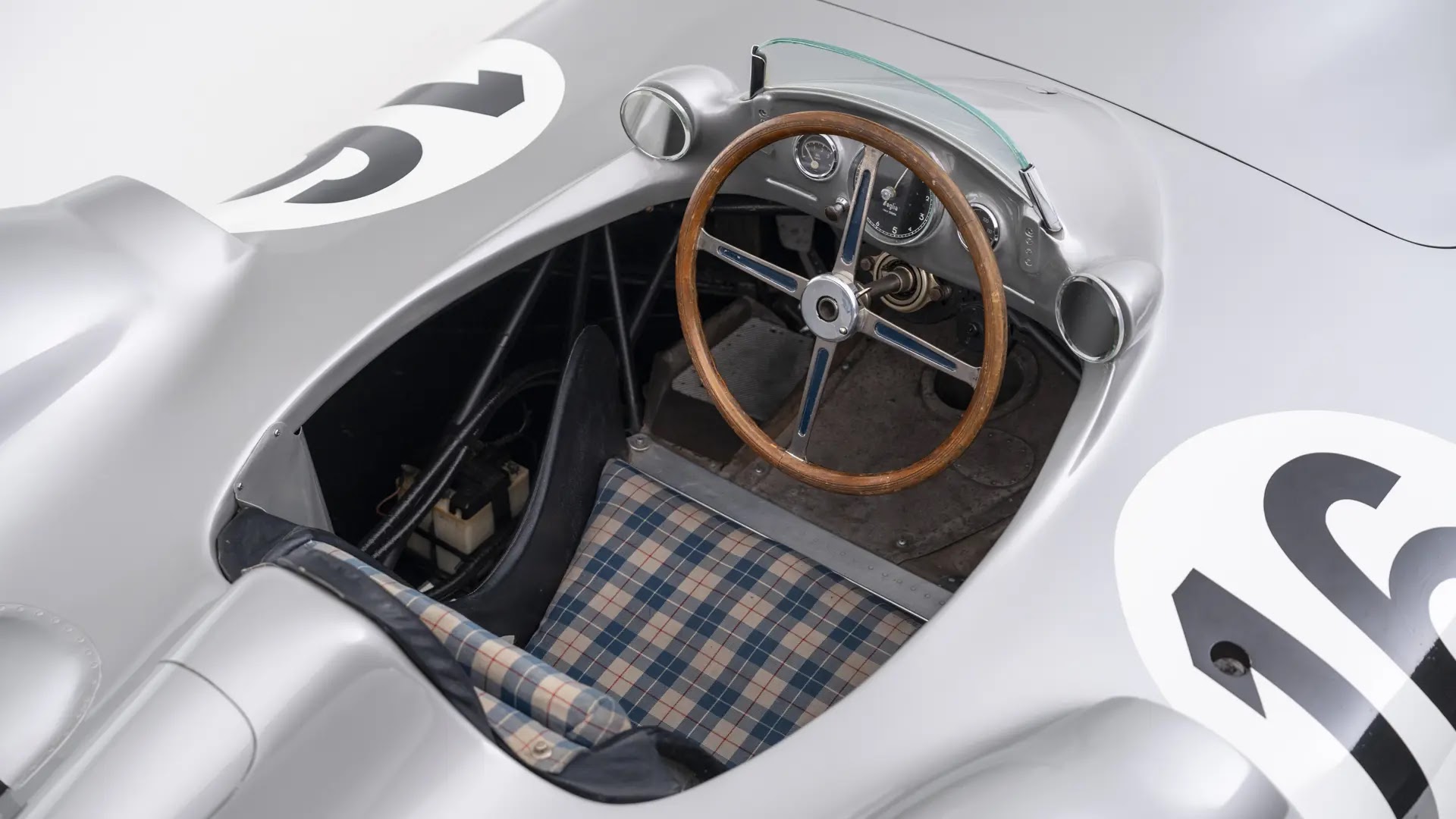
As chief of the Experimental Department, Rudolf Uhlenhaut was the principal engineer overseeing the new grand prix model’s development. He began with a truss-type narrow-diameter tubular space frame similar to the W 194 300 SL racing car’s chassis. Dubbed the W 196 R, this chassis was equipped with front independent suspension via double wishbones, torsion-bar springs, and cutting-edge hydraulic telescopic shock absorbers. More significantly, the rear suspension was governed by a low-pivot swing axle that was personally developed by Uhlenhaut, a design feature that would later reappear in the 300 SL Roadster production car. Massive Alfin drum brakes were specified to keep the W 196 R grounded, and they were mounted inboard to lower unsprung mass.
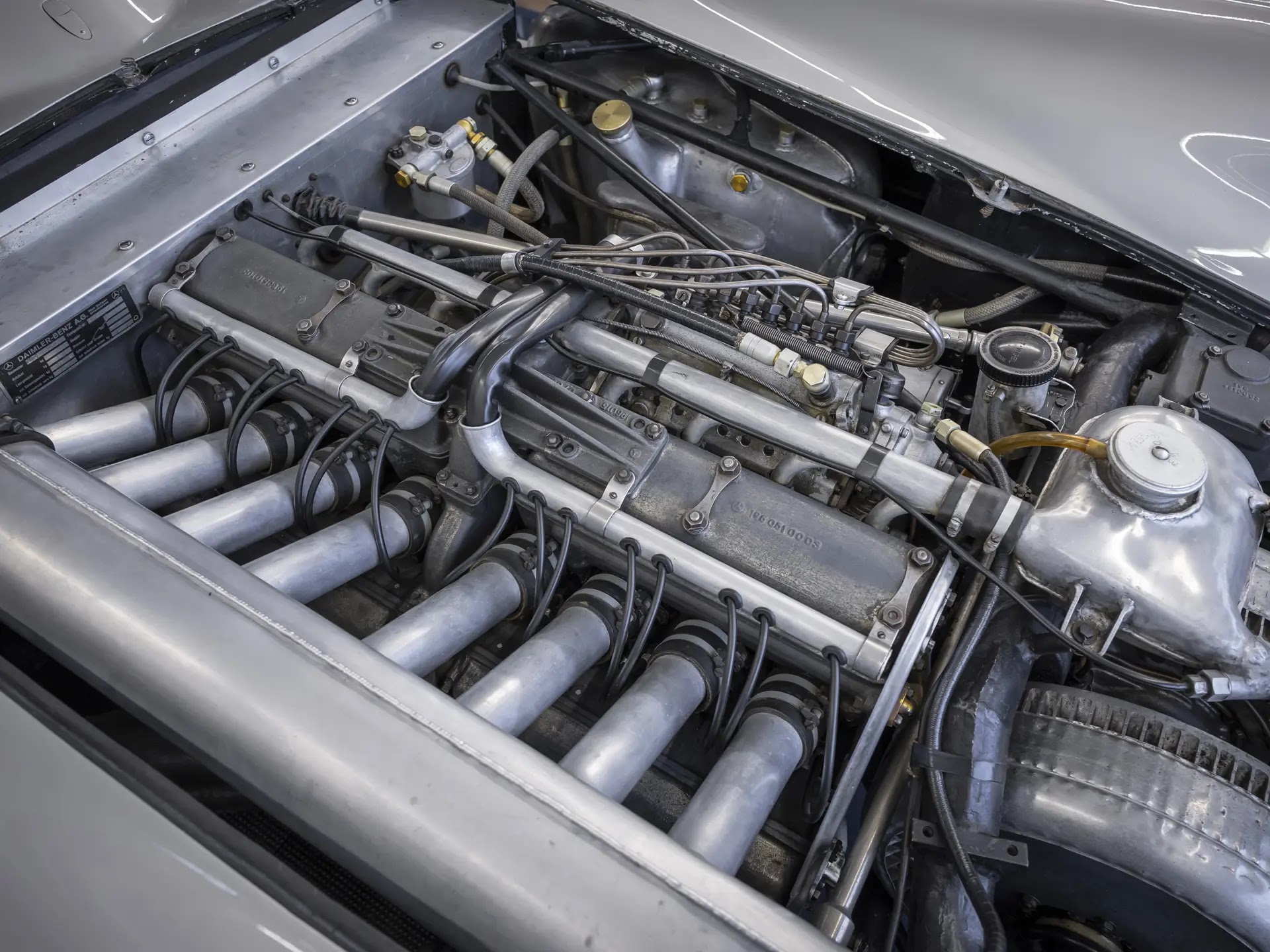
Having run both supercharged inline eight-cylinder and V-12 engines during the interwar period, the racing department had several options to test, and eventually concluded that a straight-eight configuration displacing 2,494 cubic centimeters would deliver the most consistent power. Designed around a complex Hirth roller-bearing crankshaft, the engine was essentially two four-cylinder motors in unison, with two camshafts for each intake and exhaust. This jewel of an engine was equipped with racing components like dual ignition and dry-sump lubrication while featuring revolutionary desmodromic valve gear instead of standard valve springs; and Bosch high-pressure direct fuel injection that guaranteed reliable and smooth power application.
The purpose-developed M 196 engine initially developed a robust 257 horsepower, which was gradually improved over two seasons to 290 horsepower. The motor was positioned low in the front compartment, canted by between 20 and 37 degrees to save space, and coupled to a rear-mounted five-speed gearbox actuated by a single-disc dry clutch. The gearbox unusually featured synchros in the upper four gears, while a limited-slip differential ensured superior traction. Fuel was provided by tanks ranging in capacity from 107 to 199 liters, with compartmented baffles that reduced sloshing issues.
Since the new formula specified so few limitations to coachwork, Nallinger and Uhlenhaut concluded that a streamlined aerodynamic body with enclosed wheels would optimize high-speed courses, while an open-wheel grand prix body would be ideal for more twisting circuits. Sleek and purposeful, the W 196 R’s torpedo-shaped open-wheel body was drawn up along lines that were largely conventional for the era.
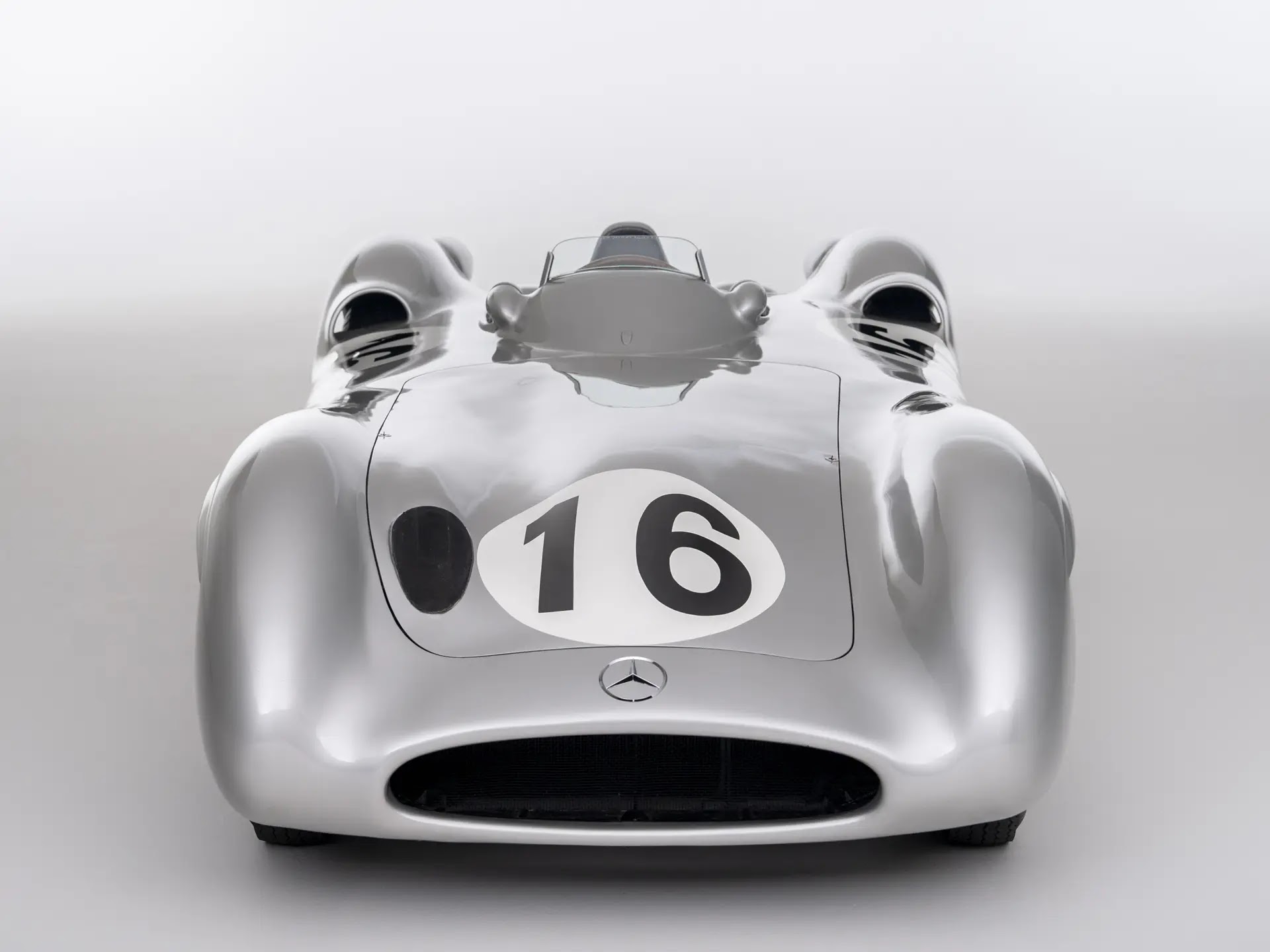
The streamlined body, in contrast, was something truly unique. Low and wide, its smoothly curved coachwork featured minimal frills, being chiefly distinguished by a wide open-mouth grille, cooling inlets on the rear shoulder haunches, and molded character lines across the tops of the front wheel wells (a design cue that came to be characteristic across the 300 SL model line, lending a marvelous continuity among the marque’s sports-racing cars). This was undoubtedly one of the most exquisite expressions of curve and stance ever pounded out, rivalling the most sensuous sports-racers and supercars for sheer visual appeal.
These streamlined bodies were built in extremely limited quantity by the racing department out of Elektron magnesium alloy, providing a shell even lighter than aluminum for a total weight of just over 88 pounds. The open-wheel bodies were also made of lightweight alloy, although coachwork production later shifted to steel bodies built at Sindelfingen.
The streamlined enclosed-wheel body was intermittently campaigned with the open-wheel grand prix-style body during the 1954 and 1955 racing seasons. The factory designation for the enclosed-wheel coachwork was Stromlinie, or Streamline, and today these cars are also known as Streamliner or Stromlinienwagen (streamlined car). With such powerful mechanical specifications and slippery lightweight coachwork, the W 196 R could exceed 186 mph, making it one of the fastest grand prix cars yet constructed.
1954, a perfect plan realized:
Of course, Alfred Neubauer, the longtime manager of the Mercedes Benz racing team, knew that the W 196 R’s success would be contingent on driving talent, so the decision was made early in development to contract the best array of available drivers. While two German drivers were initially signed, the veteran Karl Kling and the up-and-coming Hans Herrmann, the spotlight soon belonged to the third team member: noted Argentinian racing driver Juan Manuel Fangio.
There was a time in the late 1950s when the five-time Formula One champion Juan Manuel Fangio enjoyed a fame that transcended motorsport—when he was a true worldwide celebrity not unlike Lewis Hamilton today, and when grandstands rang out with passionate chants of “FONN-GEE-OHHH!”
Before he was a household name, in early 1954 Juan Manuel Fangio was merely a potential in transition, a burgeoning talent waiting to explode. Without a doubt, Fangio’s credentials had already been established with his first Drivers’ Championship for Alfa Romeo in 1951. But with the disintegration of the Alfa Romeo team during 1952 and the FIA’s subsequent cancelation of Formula One in favor of Formula Two proceedings, Ferrari dominated the following two years of competition. Fangio toiled away patiently with the Maserati team, and in sports car racing. Victories came repeatedly, but further championships remained elusive, and having reached his early forties, there was a justifiable presentiment among racing fans that Fangio’s best days were already behind him.
Fortunately for Fangio, his star had already been recognized by Stuttgart. Ever in search of the best driving talent, Alfred Neubauer could not help but remember Fangio’s remarkable performance in an Alfa Romeo at the 1951 Swiss Grand Prix—achieving pole, fastest lap, and a 1st-place finish. Neubauer reached out to Fangio’s agent and a contract for 1954 was signed with Mercedes Benz. But as the 1954 season began, the new machine from Stuttgart still awaited completion. This led Fangio to continue racing for Maserati in the first two rounds of the 1954 Formula One season, winning the Grands Prix at both Argentina and Belgium. Following the Belgian Grand Prix, Fangio officially made the move to Mercedes Benz.
In July 1954 the new Mercedes Benz race cars made their highly anticipated debut at the French Grand Prix at Reims. Debuting a trio of W 196 R Streamliners, their very appearance inspired awe, looking unlike anything anyone had ever seen before in a Formula One race. Team drivers Fangio, Kling, and Herrmann would qualify 1st, 2nd, and 7th, respectively. Herrmann would go on to set the race’s fastest lap while Fangio and Kling would achieve an impressive 1-2 finish. The race marked a resounding victory for Mercedes Benz on its long-awaited return to racing.
Fangio qualified for the pole position start at the British Grand Prix in late July, but rainy conditions led to a 4th-place finish. The team returned to form at the German Grand Prix at the Nürburgring in early August with a four-car team consisting of three open-wheel cars and one Streamliner. The race marked the debut of the open-wheel iteration of the W 196 R. Fangio earned pole position and would go on to win the race with Kling finishing 4th, each in open-wheel cars. A three-car team, all open-wheel, at the Swiss Grand Prix three weeks later brought nearly identical results, with Fangio again winning and Herrmann finishing 3rd.
At the Italian Grand Prix at the Monza circuit in early September, Mercedes Benz entered two Streamliners and one open-wheel car after testing indicated that the closed-fender coachwork would be faster. In the race, a young British privateer named Stirling Moss behind the wheel of a Maserati 250F led late in the race 19 laps before retiring due to a cracked oil tank. Fangio in a Streamliner and Herrmann in an open-wheel car respectively cruised to 1st and 4th place finishes. The performance of the talented Englishman likely did not escape the attention of Rudolf Uhlenhaut and Alfred Neubauer.
Two weeks later the W 196 R cars were entered at a non-championship race, the Berlin Grand Prix, which was held at the AVUS circuit. With no points consequence, this was almost strictly a public relations demonstration for an enthusiastic German audience. Three Streamliners driven by Kling, Fangio, and Herrmann cruised to an easy 1-2-3 podium sweep.
At the Spanish Grand Prix in late October, the last race of the year, Fangio finished a team-best 3rd among a contingent of three open-wheel entries. The legend of Juan Manuel Fangio had grown; his second Drivers’ Championship was in the books. The sheer and immediate potency of the Mercedes Benz W 196 R Silver Arrow had been established, foiling Ferrari’s attempt at a third straight Formula One championship in the process.
In the midst of this immediate show of dominance for the W 196 R, chassis number 00009/54, the car offered here, was completed. Originally finished as an open-wheel monoposto built on the 1954-specification 2,350-millimeter long-wheelbase chassis, and being designated with a 54 in its chassis number suffix (1955 cars have a 55 suffix), the car first began testing on 15 December 1954. For chassis number 00009/54, as well as for the victorious Mercedes Benz racing team, even greater things were to come in the season ahead.
Chassis number 00009/54 in competition: Open-wheel.
For the 1955 season, the W 196 R was further developed to remain as competitive as possible. The engine was improved in numerous aspects, including the addition of a new intake manifold, and the decision was made to run the open-wheel grand prix bodies for almost all of the 1955 races. The revised cars were approximately 70 kilograms (154 pounds) lighter than their predecessors. Further testing demonstrated that the 1954 W 196 R had been significantly compromised by its Continental tires, so the rubber manufacturer was taken to task to deliver a better product, and their development during the off-season was a critical boon for the revised car.
The Rennabteilung again went after top driving talent, recruiting the upstart 25-year-old Brit from Monza, Stirling Moss, to join their stable of drivers. Moss eventually became a well-known celebrity in his own right, and one of the most famous of all the notable British drivers. Though his career would be prematurely cut short by an accident in 1962, he remained a forthright proponent of motorsports and a supporter of the automotive niche throughout his life, even serving as a brand ambassador for Mercedes Benz in his twilight years. His lifelong contributions to the sport and Britain’s motoring niche were recognized in 2000 when he was knighted by the future King Charles.
But during the early 1950s Moss was still steadily developing as a privateer, an evolution that had begun with his win at the 1950 Tourist Trophy. To the end of securing a spot on the Mercedes Benz team, in 1953 he bought and raced a true Formula One specification car, the Maserati 250F. Though the 250F was somewhat unreliable in competition, Moss showed considerable promise during several impressive qualifying sessions, and Neubauer took note after the events of the 1954 Italian Grand Prix. By December 1954 Moss was hired and practicing in the W 196 R, familiarizing himself with the car’s nuances while marveling at the Rennabteilung’s team environment.
Moss later wrote of the Mercedes Benz team, “Their thoroughness and thoughtfulness amazed me from the very beginning. It was like being in a different world…Every course where the cars raced was analyzed mathematically…Neubauer himself used to mark and time gearchanges, lap after lap…Drivers were listened to and respected, which often doesn’t happen on other top teams…Nothing was too much trouble—and they were willing to try anything which might improve performance.”
There was no doubt that Mercedes Benz’ commitment had come to fruition in 1954, and it was about to bear further fruit with Moss onboard. It was Fangio, however, that set the winning tone with a victory at round one of the 1955 Formula One season at the Argentine Grand Prix on 16 January 1955. Since the next Formula One points event on the calendar didn’t arrive until late May, the team remained in Argentina to conduct some live-action testing during the Buenos Aires Grand Prix, as the Formula Libre race’s lack of regulations proved to be a popular testbed for Formula One teams.
The Formula Libre Buenos Aires Grand Prix on 30 January 1955 would mark the first race for the car on offer, chassis number 00009/54, piloted by none other than Juan Manuel Fangio as car #2. According to Rennabteilung build sheets on file, as well as recent confirmation by Mercedes Benz, chassis number 00009/54 was equipped with a “Sport 59” engine, apparently code for the 3.0-liter M196 engine, and fitted with an open-wheel monoposto body. One of the team’s primary objectives for this non-Formula One event was apparently to test this new development of the M196 engine, which was positioned for use in the upcoming W 196 S sports car, the 300 SLR. Moss, Kling, and Herrmann joined Fangio—each racing an open-wheel car.
The Buenos Aires Grand Prix race format was a bit unusual: two separate heats of 30 laps each, with the winner determined by the fastest total aggregate time. While Fangio earned the pole position during a rainy qualifying session, Moss leapt out to lead the first heat. Fangio made his move during the 13th lap, briefly holding 1st place before being overtaken by Giuseppe “Nino” Farina’s Ferrari 625, and this order held until the finish line with Fangio 10.5 seconds behind. During the second heat many drivers switched cars, and Fangio initially led before being passed by Moss, who went on to win the heat by three seconds in an exciting finish. Despite finishing 2nd in both heats, Fangio achieved the lowest total time of 2:23:18.9, besting Moss by 11.9 seconds, the 625 Ferrari by over half a minute, and Kling by nearly a minute, thus capturing the win for the Rennabteilung in this important first outing for chassis number 00009/54.
The victory gave Fangio a sweep of that season’s races in his native country, having won the Formula One Argentine Grand Prix two weeks prior. The impressive finish at the Buenos Aires Grand Prix was commemorated in-period, with Mercedes Benz commissioning a beautiful race poster by Anton Stankowski celebrating the 1-2-4 Fangio-Moss-Kling finish.
At the Monaco Grand Prix in late May, Fangio was given a new open-wheel car built on an extra short-wheelbase chassis (2,150 millimeters), and though he qualified for the pole, Herrmann then crashed the car in practice. The team’s luck only got worse during the race, where three cars retired early with valve-gear failures and Moss struggled to a 9th place finish.
In June, Fangio and Moss roared to 1-2 finishes at both the Belgian Grand Prix and the Dutch Grand Prix before a number of grands prix were cancelled in response to the recent accident at Le Mans. When action resumed at the British Grand Prix at Aintree in mid-July, the Mercedes Benz team dominated again, with the experienced home-court veteran Moss leading a four-car contingent to a commanding 1-2-3-4 finish (Moss-Fangio-Kling-Taruffi), the only quadruple victory in marque history.
This set the stage for the season’s final contest—and 00009/54’s final competition outing: the Italian Grand Prix at Monza in September.
Chassis number 00009/54 in competition: Stromlinienwagen.
For 1955, the Monza circuit was rebuilt with a new high-speed bank that has since become legendary in motorsport. With this development, the Rennabteilung already knew the course would favor a Streamliner body, despite the fact that they had been running the open-wheel coachwork exclusively up to this point for the 1955 season. During testing at Monza in August, the team experimented with a new protruding nose piece for the Stromlinienwagen, but results were inconclusive. Ultimately, the medium-wheelbase chassis was chosen to be mounted with new length-adapted Streamliner coachwork in the original style, with the exception of a new air inlet next to the hood to feed the canted engine. Two such cars were built at Untertürkheim.
When practice for the race ensued a month later, the medium-wheelbase Streamliner was found to be twitchy at high speeds. Fangio then assumed the use of a spare Streamliner built on an original long-wheelbase chassis from 1954, and Moss quickly requested an identical car, so Neubauer contacted the workshop and ordered a Streamliner to be delivered to Monza as soon as possible. A spare long-wheelbase chassis, number 00009/54, was mounted with a Streamliner body and immediately dispatched to Monza.
Mercedes Benz would send eight cars, nearly all their running W 196 Rs, to what would be the model’s swan song in competitive racing. Of the eight cars sent to the track, four cars were entered by Mercedes Benz for the race, with Fangio and Moss competing in W 196 R Streamliners and Kling and Piero Taruffi behind the wheels of W 196 R open-wheel monopostos.
This car, chassis number 00009/54, was the aforementioned long-wheelbase Streamliner delivered on request for Moss after the medium-wheelbase Streamliners had been declined by Fangio and himself. Stirling Moss, driving under #16, would pilot chassis number 00009/54 in the race. Fangio would secure pole position, with Moss securing 2nd starting position just three-tenths of a second behind Fangio. Kling would qualify 3rd, and Taruffi 9th; the advantage of the Streamliner bodywork at the fast Monza track was evident.
From the start, Fangio and Moss held their 1-2 start. Moss would take the lead from Fangio in the 9th lap of the race, but it was short-lived, as Fangio would regain the lead in lap 9 and retain 1st position for the remainder of the race. Moss would go on to hold onto 2nd through lap 18, when he was forced to pit to replace the windscreen, dropping him down to 8th by the time he rejoined the race. Moss would climb to 7th but was soon forced to retire due to a failing piston in cylinder five after completing 27 laps. Completing just over half the race, Moss was still able to achieve the race’s fastest lap at an impressive 2:46.900 in chassis number 00009/54. His average speed of 215.7 km/h on lap 21, while attempting to make up ground following his early pit stop, earned him one point towards the Formula One Drivers’ Championship.
Karl Kling would retire from the Italian Grand Prix shortly after Moss, pulling out of the race with a defective cardan shaft after 32 laps. Fangio would go on to win, tailed closely by Taruffi just seven-tenths of a second behind. The impressive 1-2 finish—a fitting bookend to the W 196 R Stromlinienwagens’ triumphant 1-2 victory at their debut outing, the 1954 French Grand Prix at Reims—would not be replicated again by Mercedes-Benz as a constructor for 58 years, with Lewis Hamilton and Nico Rosberg at the 2014 Malaysian Grand Prix.
At the conclusion of the 1955 Formula One season, Fangio captured his second straight World Drivers’ Championship, with Moss finishing 2nd, sealing the W 196 R Silver Arrow’s legend in the process. Moss, meanwhile, had captured two World Sportscar Championship victories in the 300 SLR, including his storied win at the 1955 Mille Miglia in the #722 car with co-driver Denis Jenkinson. This proved to be enough to edge out Ferrari for a narrow championship victory in sports car racing. Significantly, the 300 SLR, internally designated the W 196 S, was the two-seat sports car development of the W 196 R; the 300 SLR benefitted from a larger 3.0-liter motor, the likes of which had been proven in chassis number 00009/54 in Buenos Aires.
The W 196 R’s pedigree was now unimpeachable. In two seasons the model had won three championships in two different racing series. In 12 appearances at Formula One points events the W 196 R had won a commanding nine times, and it won two additional non-points races, totaling 11 victories in 14 starts. This 78 percent represents an incredible winning rate by any measure. It is also important to note that the World Constructors’ Championship had not yet been created; had it existed, Mercedes Benz surely would have won this title, as well.
At the end of an era:
Having demonstrated that they could dominate on the track Mercedes Benz chose to make a graceful exit once again from motor racing after 1955, bowing out for the next few decades—and further ensuring that the remarkable legend of the W 196 R would never be forgotten.
At the conclusion of 1955, 10 different complete W 196 R examples remained in running order, including four with Stromlinienwagen coachwork. Fourteen chassis had been built in total, designated with numbers 1 to 15. (Chassis numbers 1 and 15 were eventually scrapped, and number 11 was never actually assigned to a chassis.) In October 1955, Mercedes Benz held an official ceremony to retire the W 196 R, publicly shrouding the cars in dust sheets before transferring them to the company’s museum in Stuttgart. Following the completion of its competition duties but prior to being stored, chassis number 00009/54 had been—in keeping with common post-race procedure—partially dismantled and equipped with a new engine, among other items. While the Daimler-Benz Museum initially retained all 10 remaining W 196 R examples, four cars were eventually donated to prestigious museums around the world, including chassis number 00009/54.
The post-racing path of chassis number 00009/54 was set in motion in September 1964, when a contingent from the Mercedes Benz Club of America visited the marque’s Untertürkheim plant in Stuttgart. As detailed by a wealth of correspondence on file, during this visit, a conversation ensued between the club’s Wilhelm “Bill” Spoerle and the manufacturer’s Dr. -Ing Friedrich Schildberger about donating a race car to the “planned new museum on the grounds of the Indianapolis Motor Speedway.”
A German immigrant who once worked in NSU’s motorcycle racing division before the war, Mr. Spoerle had moved to Indianapolis in 1956 to work on racing cars, taking a position at the nascent Dreyer Motorsports for several years. Eventually lured away by Anton “Tony” Hulman Jr. in 1963, Spoerle became the Restoration Manager at the relatively new museum at the Brickyard. By the time of Spoerle’s visit to Untertürkheim he was already working for Tony Hulman, and he surely realized there could be no better place for a W 196 R donation than the Indianapolis Motor Speedway Museum.
Tony Hulman was a typical example of one of motorsports’ classic archetypes—the colorful business-savvy impresario who has arrived at racing rather late in life and by accident, but is bitten by the bug and comes to love it. From Terre Haute, Indiana, Hulman was the scion of a fortune built on an eponymous grocery distribution business. He worked his way up through the family business, eventually becoming president in 1931, while excelling in imaginative marketing approaches such as the ad campaign for the firm’s Clabber Girl baking powder.
The Brickyard had fallen into a surprising state of disrepair by late 1941 when racing was canceled after the attack on Pearl Harbor. After the war, the track’s owner, former World War I flying ace Eddie Rickenbacker, was content to sell the circuit to whomever might want it, for any use at all. But former three-time Indianapolis 500 winner Wilbur Shaw was adamant that the Brickyard should only be sold to someone intending to keep it open for racing. After searching high and low, Shaw found Hulman, who officially purchased the speedway in November 1945, and quickly set about renovations for the planned 1946 Indianapolis 500, the first post-war edition of the legendary race. Hulman continued to regularly improve the course over the years, while notably founding the Indianapolis Motor Speedway Foundation, a separate non-profit organization created in part as the financial/business facade for the new IMS Museum.
As MercedesBenz president Walter Hitzinger and chief engineer Dr. Nallinger explained in a March 1965 letter to Hulman, “In view of the special significance of Indianapolis in the history of automobile racing and also in particular view of our own company’s contribution, we have now decided to give you a 2.5 litre streamlined car, Type W 196, built in 1954, as a gift for exhibition in your museum.” Mercedes Benz had a tie to America’s greatest race, having won the race in just its fifth running in 1915 when Ralph DePalma drove a Mercedes to victory in what proved to be one of just a handful of Indianapolis 500 wins for a European manufacturer.
Dr. Schildberger set about re-commissioning the W 196 R so that it could be driven during an official presentation at the Brickyard, which was planned for the weekend of the 1965 Indianapolis 500. For this exhibition, Mercedes Benz ordered 50 gallons of Esso (Exxon) racing fuel to be delivered. The Stromlinienwagen was shipped through the port of Baltimore in late April and trucked to Indianapolis.
Officially donated to the Indianapolis Motor Speedway Foundation on Sunday, 30 May 1965, the Mercedes Benz made two appearances during the weekend. The first came at an informal presentation after the annual driver’s meeting, where the car was demonstrated by Peter DePaolo in honor of the Mercedes victory 50 years earlier by his uncle, Ralph DePalma. The following day DePaolo again took the wheel before Monday’s feature race, after the car had officially been presented to the IMS Museum by Mercedes Benz.
Life in retirement:
For almost six decades, the W 196 R has been fastidiously stored and maintained by the Indianapolis Motor Speedway Museum, occasionally being invited to attend important exhibitions, such as the 1996 Amelia Island Concours d’Elegance, the 2003 Canadian International AutoShow, and the grand re-opening of the redesigned Petersen Automotive Museum in December 2015. The car participated in the first Velocity Invitational (then called Sonoma Speed Festival) event at Sonoma Raceway in 2019, and it was then shown at the Amelia Island Concours d’Elegance once again in 2020.
The W 196 R has been displayed at the IMS Museum periodically, including the 2020–2021 “From the Vault” exhibition; when not on display, it was part of the Basement Collection VIP tours of the Museum’s vehicle storage location. From July 2022 to January 2023, chassis number 00009/54 was again shown at the Peterson Automotive Museum as part of the "Andy Warhol: Cars — Works from the Mercedes Benz Art Collection" exhibit. Most recently, it was part of the Mercedes-Benz display at the 2024 Pebble Beach Concours d’Elegance. In the interest of a true educational mission, however, the car has never been submitted for judging at concours events.
The Streamliner has been treated to two mild bouts of sympathetic freshening during its more recent lifetime, first undergoing a refinish in the correct DB 180 Silver Metallic in 1980, with race #16 in white roundels, as per the 1955 Monza livery when driven by Stirling Moss. In late 2015, in preparation for its display at the Petersen Museum, the car received a second refinishing of the coachwork by the esteemed experts at Canepa Motorsports in Scotts Valley, California, and it continues to be a startling testament to the brilliance of the Stromlinenwagens at Monza.
There is no small irony in the fact that this W 196 R has spent so many decades in the care of the IMS Museum. For at the end of the 1955 season, according to motoring historian Karl Ludvigsen in his book Mercedes Benz: Quicksilver Century, some minds at Mercedes Benz wondered how the model might fare in the Indianapolis 500. Initial research and development calculations were undertaken to create performance projections. But after these initial calculations were made, the pursuit was dropped in the face of anticipated high costs and a lack of pure necessity. The W 196 R had achieved everything it was built to do; no further campaigning was necessary. Its shocking form, however, inspired a number of Indianapolis 500 hopefuls—perhaps most notably Jimmy Daywalt and the Sumar Special—to incorporate elements of its streamlined design into their own cars for 1955.
It should now be very evident that chassis number 00009/54 is a diamond of extraordinary cut, emitting a brilliance that is almost impossible to fathom. The car is one of just 14 chassis built, and it is believed to be one of just 10 known complete examples surviving at the conclusion of the 1955 Formula One season. Of those, this example was one of only four mounted with the magnificent Streamliner coachwork at the conclusion of the 1955 Formula One season. It was an integral component of the factory racing campaign that saw Mercedes Benz capture two Formula One Drivers' Championships in as many attempts, and one World Sportscar Championship during the same period.
Further driven to victory by Fangio at the 1955 Buenos Aires Grand Prix, and to the fastest lap by Stirling Moss at the 1955 Formula One Italian Grand Prix at Monza, this W 196 R had been piloted by two of history’s most famous and accomplished racing drivers. Following one of the most successful competition campaigns imaginable, the car was retired to the stately in-house collection of Mercedes Benz before being donated nine years later to the equally respected Indianapolis Motor Speedway Museum, whose collection includes some of the finest racing cars the world has ever seen.
Chassis number 00009/54 represents only the second W 196 R ever offered for private ownership, and the sole example offered with the magnificent Streamliner coachwork. Presented in its proper Monza livery from the 1955 Italian Grand Prix, and documented with a trove of period materials, chassis number 00009/54 has moreover never been formally presented for judging or driven in any vintage events; it should experience a rapturous welcome at any of the major events for which it is eligible. Ideal for display at flagship concours d’elegance like Pebble Beach or Villa d’Este, the magnificent W 196 R will surely also experience great acclaim at significant marque events worldwide. Note that after many years of static display at the Indianapolis Motor Speedway Museum, chassis number 00009/54 will require careful recommissioning prior to starting or driving.
The future caretaker can take pride in ownership of a bona fide competition legend that is one of Formula One’s most successful models ever, bar none. Absolutely astonishing in every respect, from its advanced, powerful engineering and truly singular coachwork to its remarkable history—driven by two of the biggest names in motorsports, this W 196 R Stromlinienwagen is a gem without parallel. It now awaits the expected ardor of Formula One enthusiasts, dedicated marque collectors, and lovers of the all-but-unobtainable—sure to redefine our very understanding of what is possible. Texto da RM / Sotheby's.
Nota do blog: Data nas imagens (quando obtidas) / Crédito das imagens Mercedes Benz.

Italian Grand Prix at Monza, 11 September 1955. Eventual winner Juan Manuel Fangio (#18) is followed by Stirling Moss (#16, chassis number 00009/54).


Juan Manuel Fangio (#2), the eventual winner, leads Stirling Moss (#6) in the Formula Libre Buenos Aires Grand Prix, 30 January 1955.

Juan Manuel Fangio (#2) leads Stirling Moss (#6) in chassis number 00009/54 at the 1955 Formula Libre Buenos Aires Grand Prix.

Juan Manuel Fangio (#2) drives W 196 R chassis number 00009/54 in a training run ahead of the 1955 Buenos Aires Grand Prix.

Juan Manuel Fangio (#2) drives W 196 R chassis number 00009/54 in a training run ahead of the 1955 Buenos Aires Grand Prix.
Fotografia
Shine bright like a diamond:
When evaluating the merits of a so-called legendary racing car, it is imperative to assess it from every angle. Design considerations, engineering provenance, competition pedigree, races won, and drivers utilized all factor in. How successfully did it meet its design brief, and how enduring was its competition success? What was its post-racing life and its private ownership provenance, and what is its current quality? Finally, and not least of all, is the dynamism of its overall presence.
In effect, the halo collectible racing car is like a diamond. To be considered of optimal quality, every facet of the car’s unique cut must emit a brilliance that leaves one speechless.
All of which informs our understanding of the current offering, the 1954 Mercedes Benz W 196 R Stromlinienwagen, chassis number 00009/54. Rarely has a racing car emanated brilliance on so many levels. Yet, like any great car, the story of chassis number 00009/54 is not just that of a machine but one of men—and a more compelling group of racing luminaries would be nearly impossible to match. A London-born German engineer with a process so uniquely exacting it seems torn from the pages of a novel; an Argentinian racing veteran nearing the peak of his driving supremacy and worldwide celebrity; a young British driver of no less skill who would one day be knighted by the future King of England; and an American businessman raised to sell food who invested in Gasoline Alley and bought a ticket to immortality on the Brickyard.
Rudolf Uhlenhaut—Juan Manuel Fangio—Stirling Moss—Tony Hulman. These four men form the arc of this W 196 R’s story, from the hallowed grounds of Mercedes Benz’ Rennabteilung (Racing Department), to the stifling heat of Buenos Aires in January, to the brand-new high-speed banks of the Monza circuit, to one of the shrines of motorsport in Indianapolis.
Our story begins with a humble engineering student in Munich at the dawn of the thirties when Germany was undergoing some of the worst symptoms of the crushing Great Depression. The London-born Rudolf “Rudi” Uhlenhaut was hired by Mercedes Benz straight out of school in 1931, and he spent the next five years proving his mettle in the production car department, increasingly recognized for his quiet demeanor, strong work ethic, and unusual sense of commitment. During this time Mercedes Benz returned to racing, and in 1934 and 1935 the works team enjoyed great success, giving rise to the W 25 racecars known as the Silver Arrows, for their unfinished metal coachwork. Despite these initial successes, Stuttgart suffered a setback in 1936 when that year’s new car failed to meet expectations, and changes were soon afoot.
The promising Rudolf Uhlenhaut was promoted to director of the experimental department for racing, which was somewhat of a surprise given that he had no experience in racecar development. He was to work under racing department director Dr. Fritz Nallinger, and in conjunction with racing team manager Alfred Neubauer. Keenly aware of how little he knew about competition cars, Uhlenhaut threw himself into the assignment with characteristic zeal, learning the ins and outs of racecar behavior by privately testing the cars on the Nürburgring. Team drivers marveled at how quickly Uhlenhaut became shockingly good, as he insisted on testing cars at racing speeds to properly replicate in-race conditions, occasionally even besting team-driver lap times in the process. He was also the only Daimler-Benz engineer who routinely traveled with the racing team, and his direction led to key improvements for the 1937 car, the W 125. Uhlenhaut proceeded to the highly successful W 154 and W 165 racecar programs before war broke out in September 1939.
A new silver arrow rises from the ashes:
Upon resuming production following World War II, Mercedes Benz faced the daunting task of contributing to rebuilding Germany while finding a profitable niche in the post-war economy. As with most European marques, the company began with inexpensive and efficient models that assumed a pre-war design, being positioned for the common working man, while gradually delving into more luxurious offerings. With the introduction of the 300 S model in 1951, Stuttgart signaled its intention to resume the manufacture of luxury and sporting automobiles, and it came as no surprise that this growth would include a return to motorsports competition.
The company’s return to the track began softly, with a new sports car called the 300 SL “Gullwing,” which was created under the management of Rudolf Uhlenhaut. In its earliest W 194 iteration, the 300 SL created a stir in styling and competition that set the table for both further sports car racing, and series production of the popular W 198 300 SL Gullwing production model. But the most natural segway for Stuttgart’s return to high-level racing was afforded by the FIA’s odd cancellation of Formula One for 1952 and 1953, which was prompted by a lack of credible competition.
With this conundrum in mind, the FIA stipulated new Formula One regulations that would go into effect for the 1954 season. This advance notice gave all interested manufacturers well over a year to develop a suitable competition car. The new formula was relatively simple; it specified that normally aspirated engines could not exceed 2.5 liters, while blown engines were limited to a comical 750 cubic centimeters. Other than mandating a single centered seat, the rules for coachwork were unspecific.
Fritz Nallinger and his fellow directors at Mercedes Benz recognized this new formula as a unique opportunity to return to the company’s motorsports roots in grand prix racing, and with characteristic efficiency, a plan was put in motion to field the best possible car. A new, well-staffed Rennabteilung (racing department) was created, including a traveling factory team. At their disposal lay the full budget and managerial assets of Mercedes Benz’s considerable infrastructure.
As chief of the Experimental Department, Rudolf Uhlenhaut was the principal engineer overseeing the new grand prix model’s development. He began with a truss-type narrow-diameter tubular space frame similar to the W 194 300 SL racing car’s chassis. Dubbed the W 196 R, this chassis was equipped with front independent suspension via double wishbones, torsion-bar springs, and cutting-edge hydraulic telescopic shock absorbers. More significantly, the rear suspension was governed by a low-pivot swing axle that was personally developed by Uhlenhaut, a design feature that would later reappear in the 300 SL Roadster production car. Massive Alfin drum brakes were specified to keep the W 196 R grounded, and they were mounted inboard to lower unsprung mass.
Having run both supercharged inline eight-cylinder and V-12 engines during the interwar period, the racing department had several options to test, and eventually concluded that a straight-eight configuration displacing 2,494 cubic centimeters would deliver the most consistent power. Designed around a complex Hirth roller-bearing crankshaft, the engine was essentially two four-cylinder motors in unison, with two camshafts for each intake and exhaust. This jewel of an engine was equipped with racing components like dual ignition and dry-sump lubrication while featuring revolutionary desmodromic valve gear instead of standard valve springs; and Bosch high-pressure direct fuel injection that guaranteed reliable and smooth power application.
The purpose-developed M 196 engine initially developed a robust 257 horsepower, which was gradually improved over two seasons to 290 horsepower. The motor was positioned low in the front compartment, canted by between 20 and 37 degrees to save space, and coupled to a rear-mounted five-speed gearbox actuated by a single-disc dry clutch. The gearbox unusually featured synchros in the upper four gears, while a limited-slip differential ensured superior traction. Fuel was provided by tanks ranging in capacity from 107 to 199 liters, with compartmented baffles that reduced sloshing issues.
Since the new formula specified so few limitations to coachwork, Nallinger and Uhlenhaut concluded that a streamlined aerodynamic body with enclosed wheels would optimize high-speed courses, while an open-wheel grand prix body would be ideal for more twisting circuits. Sleek and purposeful, the W 196 R’s torpedo-shaped open-wheel body was drawn up along lines that were largely conventional for the era.
The streamlined body, in contrast, was something truly unique. Low and wide, its smoothly curved coachwork featured minimal frills, being chiefly distinguished by a wide open-mouth grille, cooling inlets on the rear shoulder haunches, and molded character lines across the tops of the front wheel wells (a design cue that came to be characteristic across the 300 SL model line, lending a marvelous continuity among the marque’s sports-racing cars). This was undoubtedly one of the most exquisite expressions of curve and stance ever pounded out, rivalling the most sensuous sports-racers and supercars for sheer visual appeal.
These streamlined bodies were built in extremely limited quantity by the racing department out of Elektron magnesium alloy, providing a shell even lighter than aluminum for a total weight of just over 88 pounds. The open-wheel bodies were also made of lightweight alloy, although coachwork production later shifted to steel bodies built at Sindelfingen.
The streamlined enclosed-wheel body was intermittently campaigned with the open-wheel grand prix-style body during the 1954 and 1955 racing seasons. The factory designation for the enclosed-wheel coachwork was Stromlinie, or Streamline, and today these cars are also known as Streamliner or Stromlinienwagen (streamlined car). With such powerful mechanical specifications and slippery lightweight coachwork, the W 196 R could exceed 186 mph, making it one of the fastest grand prix cars yet constructed.
1954, a perfect plan realized:
Of course, Alfred Neubauer, the longtime manager of the Mercedes Benz racing team, knew that the W 196 R’s success would be contingent on driving talent, so the decision was made early in development to contract the best array of available drivers. While two German drivers were initially signed, the veteran Karl Kling and the up-and-coming Hans Herrmann, the spotlight soon belonged to the third team member: noted Argentinian racing driver Juan Manuel Fangio.
There was a time in the late 1950s when the five-time Formula One champion Juan Manuel Fangio enjoyed a fame that transcended motorsport—when he was a true worldwide celebrity not unlike Lewis Hamilton today, and when grandstands rang out with passionate chants of “FONN-GEE-OHHH!”
Before he was a household name, in early 1954 Juan Manuel Fangio was merely a potential in transition, a burgeoning talent waiting to explode. Without a doubt, Fangio’s credentials had already been established with his first Drivers’ Championship for Alfa Romeo in 1951. But with the disintegration of the Alfa Romeo team during 1952 and the FIA’s subsequent cancelation of Formula One in favor of Formula Two proceedings, Ferrari dominated the following two years of competition. Fangio toiled away patiently with the Maserati team, and in sports car racing. Victories came repeatedly, but further championships remained elusive, and having reached his early forties, there was a justifiable presentiment among racing fans that Fangio’s best days were already behind him.
Fortunately for Fangio, his star had already been recognized by Stuttgart. Ever in search of the best driving talent, Alfred Neubauer could not help but remember Fangio’s remarkable performance in an Alfa Romeo at the 1951 Swiss Grand Prix—achieving pole, fastest lap, and a 1st-place finish. Neubauer reached out to Fangio’s agent and a contract for 1954 was signed with Mercedes Benz. But as the 1954 season began, the new machine from Stuttgart still awaited completion. This led Fangio to continue racing for Maserati in the first two rounds of the 1954 Formula One season, winning the Grands Prix at both Argentina and Belgium. Following the Belgian Grand Prix, Fangio officially made the move to Mercedes Benz.
In July 1954 the new Mercedes Benz race cars made their highly anticipated debut at the French Grand Prix at Reims. Debuting a trio of W 196 R Streamliners, their very appearance inspired awe, looking unlike anything anyone had ever seen before in a Formula One race. Team drivers Fangio, Kling, and Herrmann would qualify 1st, 2nd, and 7th, respectively. Herrmann would go on to set the race’s fastest lap while Fangio and Kling would achieve an impressive 1-2 finish. The race marked a resounding victory for Mercedes Benz on its long-awaited return to racing.
Fangio qualified for the pole position start at the British Grand Prix in late July, but rainy conditions led to a 4th-place finish. The team returned to form at the German Grand Prix at the Nürburgring in early August with a four-car team consisting of three open-wheel cars and one Streamliner. The race marked the debut of the open-wheel iteration of the W 196 R. Fangio earned pole position and would go on to win the race with Kling finishing 4th, each in open-wheel cars. A three-car team, all open-wheel, at the Swiss Grand Prix three weeks later brought nearly identical results, with Fangio again winning and Herrmann finishing 3rd.
At the Italian Grand Prix at the Monza circuit in early September, Mercedes Benz entered two Streamliners and one open-wheel car after testing indicated that the closed-fender coachwork would be faster. In the race, a young British privateer named Stirling Moss behind the wheel of a Maserati 250F led late in the race 19 laps before retiring due to a cracked oil tank. Fangio in a Streamliner and Herrmann in an open-wheel car respectively cruised to 1st and 4th place finishes. The performance of the talented Englishman likely did not escape the attention of Rudolf Uhlenhaut and Alfred Neubauer.
Two weeks later the W 196 R cars were entered at a non-championship race, the Berlin Grand Prix, which was held at the AVUS circuit. With no points consequence, this was almost strictly a public relations demonstration for an enthusiastic German audience. Three Streamliners driven by Kling, Fangio, and Herrmann cruised to an easy 1-2-3 podium sweep.
At the Spanish Grand Prix in late October, the last race of the year, Fangio finished a team-best 3rd among a contingent of three open-wheel entries. The legend of Juan Manuel Fangio had grown; his second Drivers’ Championship was in the books. The sheer and immediate potency of the Mercedes Benz W 196 R Silver Arrow had been established, foiling Ferrari’s attempt at a third straight Formula One championship in the process.
In the midst of this immediate show of dominance for the W 196 R, chassis number 00009/54, the car offered here, was completed. Originally finished as an open-wheel monoposto built on the 1954-specification 2,350-millimeter long-wheelbase chassis, and being designated with a 54 in its chassis number suffix (1955 cars have a 55 suffix), the car first began testing on 15 December 1954. For chassis number 00009/54, as well as for the victorious Mercedes Benz racing team, even greater things were to come in the season ahead.
Chassis number 00009/54 in competition: Open-wheel.
For the 1955 season, the W 196 R was further developed to remain as competitive as possible. The engine was improved in numerous aspects, including the addition of a new intake manifold, and the decision was made to run the open-wheel grand prix bodies for almost all of the 1955 races. The revised cars were approximately 70 kilograms (154 pounds) lighter than their predecessors. Further testing demonstrated that the 1954 W 196 R had been significantly compromised by its Continental tires, so the rubber manufacturer was taken to task to deliver a better product, and their development during the off-season was a critical boon for the revised car.
The Rennabteilung again went after top driving talent, recruiting the upstart 25-year-old Brit from Monza, Stirling Moss, to join their stable of drivers. Moss eventually became a well-known celebrity in his own right, and one of the most famous of all the notable British drivers. Though his career would be prematurely cut short by an accident in 1962, he remained a forthright proponent of motorsports and a supporter of the automotive niche throughout his life, even serving as a brand ambassador for Mercedes Benz in his twilight years. His lifelong contributions to the sport and Britain’s motoring niche were recognized in 2000 when he was knighted by the future King Charles.
But during the early 1950s Moss was still steadily developing as a privateer, an evolution that had begun with his win at the 1950 Tourist Trophy. To the end of securing a spot on the Mercedes Benz team, in 1953 he bought and raced a true Formula One specification car, the Maserati 250F. Though the 250F was somewhat unreliable in competition, Moss showed considerable promise during several impressive qualifying sessions, and Neubauer took note after the events of the 1954 Italian Grand Prix. By December 1954 Moss was hired and practicing in the W 196 R, familiarizing himself with the car’s nuances while marveling at the Rennabteilung’s team environment.
Moss later wrote of the Mercedes Benz team, “Their thoroughness and thoughtfulness amazed me from the very beginning. It was like being in a different world…Every course where the cars raced was analyzed mathematically…Neubauer himself used to mark and time gearchanges, lap after lap…Drivers were listened to and respected, which often doesn’t happen on other top teams…Nothing was too much trouble—and they were willing to try anything which might improve performance.”
There was no doubt that Mercedes Benz’ commitment had come to fruition in 1954, and it was about to bear further fruit with Moss onboard. It was Fangio, however, that set the winning tone with a victory at round one of the 1955 Formula One season at the Argentine Grand Prix on 16 January 1955. Since the next Formula One points event on the calendar didn’t arrive until late May, the team remained in Argentina to conduct some live-action testing during the Buenos Aires Grand Prix, as the Formula Libre race’s lack of regulations proved to be a popular testbed for Formula One teams.
The Formula Libre Buenos Aires Grand Prix on 30 January 1955 would mark the first race for the car on offer, chassis number 00009/54, piloted by none other than Juan Manuel Fangio as car #2. According to Rennabteilung build sheets on file, as well as recent confirmation by Mercedes Benz, chassis number 00009/54 was equipped with a “Sport 59” engine, apparently code for the 3.0-liter M196 engine, and fitted with an open-wheel monoposto body. One of the team’s primary objectives for this non-Formula One event was apparently to test this new development of the M196 engine, which was positioned for use in the upcoming W 196 S sports car, the 300 SLR. Moss, Kling, and Herrmann joined Fangio—each racing an open-wheel car.
The Buenos Aires Grand Prix race format was a bit unusual: two separate heats of 30 laps each, with the winner determined by the fastest total aggregate time. While Fangio earned the pole position during a rainy qualifying session, Moss leapt out to lead the first heat. Fangio made his move during the 13th lap, briefly holding 1st place before being overtaken by Giuseppe “Nino” Farina’s Ferrari 625, and this order held until the finish line with Fangio 10.5 seconds behind. During the second heat many drivers switched cars, and Fangio initially led before being passed by Moss, who went on to win the heat by three seconds in an exciting finish. Despite finishing 2nd in both heats, Fangio achieved the lowest total time of 2:23:18.9, besting Moss by 11.9 seconds, the 625 Ferrari by over half a minute, and Kling by nearly a minute, thus capturing the win for the Rennabteilung in this important first outing for chassis number 00009/54.
The victory gave Fangio a sweep of that season’s races in his native country, having won the Formula One Argentine Grand Prix two weeks prior. The impressive finish at the Buenos Aires Grand Prix was commemorated in-period, with Mercedes Benz commissioning a beautiful race poster by Anton Stankowski celebrating the 1-2-4 Fangio-Moss-Kling finish.
At the Monaco Grand Prix in late May, Fangio was given a new open-wheel car built on an extra short-wheelbase chassis (2,150 millimeters), and though he qualified for the pole, Herrmann then crashed the car in practice. The team’s luck only got worse during the race, where three cars retired early with valve-gear failures and Moss struggled to a 9th place finish.
In June, Fangio and Moss roared to 1-2 finishes at both the Belgian Grand Prix and the Dutch Grand Prix before a number of grands prix were cancelled in response to the recent accident at Le Mans. When action resumed at the British Grand Prix at Aintree in mid-July, the Mercedes Benz team dominated again, with the experienced home-court veteran Moss leading a four-car contingent to a commanding 1-2-3-4 finish (Moss-Fangio-Kling-Taruffi), the only quadruple victory in marque history.
This set the stage for the season’s final contest—and 00009/54’s final competition outing: the Italian Grand Prix at Monza in September.
Chassis number 00009/54 in competition: Stromlinienwagen.
For 1955, the Monza circuit was rebuilt with a new high-speed bank that has since become legendary in motorsport. With this development, the Rennabteilung already knew the course would favor a Streamliner body, despite the fact that they had been running the open-wheel coachwork exclusively up to this point for the 1955 season. During testing at Monza in August, the team experimented with a new protruding nose piece for the Stromlinienwagen, but results were inconclusive. Ultimately, the medium-wheelbase chassis was chosen to be mounted with new length-adapted Streamliner coachwork in the original style, with the exception of a new air inlet next to the hood to feed the canted engine. Two such cars were built at Untertürkheim.
When practice for the race ensued a month later, the medium-wheelbase Streamliner was found to be twitchy at high speeds. Fangio then assumed the use of a spare Streamliner built on an original long-wheelbase chassis from 1954, and Moss quickly requested an identical car, so Neubauer contacted the workshop and ordered a Streamliner to be delivered to Monza as soon as possible. A spare long-wheelbase chassis, number 00009/54, was mounted with a Streamliner body and immediately dispatched to Monza.
Mercedes Benz would send eight cars, nearly all their running W 196 Rs, to what would be the model’s swan song in competitive racing. Of the eight cars sent to the track, four cars were entered by Mercedes Benz for the race, with Fangio and Moss competing in W 196 R Streamliners and Kling and Piero Taruffi behind the wheels of W 196 R open-wheel monopostos.
This car, chassis number 00009/54, was the aforementioned long-wheelbase Streamliner delivered on request for Moss after the medium-wheelbase Streamliners had been declined by Fangio and himself. Stirling Moss, driving under #16, would pilot chassis number 00009/54 in the race. Fangio would secure pole position, with Moss securing 2nd starting position just three-tenths of a second behind Fangio. Kling would qualify 3rd, and Taruffi 9th; the advantage of the Streamliner bodywork at the fast Monza track was evident.
From the start, Fangio and Moss held their 1-2 start. Moss would take the lead from Fangio in the 9th lap of the race, but it was short-lived, as Fangio would regain the lead in lap 9 and retain 1st position for the remainder of the race. Moss would go on to hold onto 2nd through lap 18, when he was forced to pit to replace the windscreen, dropping him down to 8th by the time he rejoined the race. Moss would climb to 7th but was soon forced to retire due to a failing piston in cylinder five after completing 27 laps. Completing just over half the race, Moss was still able to achieve the race’s fastest lap at an impressive 2:46.900 in chassis number 00009/54. His average speed of 215.7 km/h on lap 21, while attempting to make up ground following his early pit stop, earned him one point towards the Formula One Drivers’ Championship.
Karl Kling would retire from the Italian Grand Prix shortly after Moss, pulling out of the race with a defective cardan shaft after 32 laps. Fangio would go on to win, tailed closely by Taruffi just seven-tenths of a second behind. The impressive 1-2 finish—a fitting bookend to the W 196 R Stromlinienwagens’ triumphant 1-2 victory at their debut outing, the 1954 French Grand Prix at Reims—would not be replicated again by Mercedes-Benz as a constructor for 58 years, with Lewis Hamilton and Nico Rosberg at the 2014 Malaysian Grand Prix.
At the conclusion of the 1955 Formula One season, Fangio captured his second straight World Drivers’ Championship, with Moss finishing 2nd, sealing the W 196 R Silver Arrow’s legend in the process. Moss, meanwhile, had captured two World Sportscar Championship victories in the 300 SLR, including his storied win at the 1955 Mille Miglia in the #722 car with co-driver Denis Jenkinson. This proved to be enough to edge out Ferrari for a narrow championship victory in sports car racing. Significantly, the 300 SLR, internally designated the W 196 S, was the two-seat sports car development of the W 196 R; the 300 SLR benefitted from a larger 3.0-liter motor, the likes of which had been proven in chassis number 00009/54 in Buenos Aires.
The W 196 R’s pedigree was now unimpeachable. In two seasons the model had won three championships in two different racing series. In 12 appearances at Formula One points events the W 196 R had won a commanding nine times, and it won two additional non-points races, totaling 11 victories in 14 starts. This 78 percent represents an incredible winning rate by any measure. It is also important to note that the World Constructors’ Championship had not yet been created; had it existed, Mercedes Benz surely would have won this title, as well.
At the end of an era:
Having demonstrated that they could dominate on the track Mercedes Benz chose to make a graceful exit once again from motor racing after 1955, bowing out for the next few decades—and further ensuring that the remarkable legend of the W 196 R would never be forgotten.
At the conclusion of 1955, 10 different complete W 196 R examples remained in running order, including four with Stromlinienwagen coachwork. Fourteen chassis had been built in total, designated with numbers 1 to 15. (Chassis numbers 1 and 15 were eventually scrapped, and number 11 was never actually assigned to a chassis.) In October 1955, Mercedes Benz held an official ceremony to retire the W 196 R, publicly shrouding the cars in dust sheets before transferring them to the company’s museum in Stuttgart. Following the completion of its competition duties but prior to being stored, chassis number 00009/54 had been—in keeping with common post-race procedure—partially dismantled and equipped with a new engine, among other items. While the Daimler-Benz Museum initially retained all 10 remaining W 196 R examples, four cars were eventually donated to prestigious museums around the world, including chassis number 00009/54.
The post-racing path of chassis number 00009/54 was set in motion in September 1964, when a contingent from the Mercedes Benz Club of America visited the marque’s Untertürkheim plant in Stuttgart. As detailed by a wealth of correspondence on file, during this visit, a conversation ensued between the club’s Wilhelm “Bill” Spoerle and the manufacturer’s Dr. -Ing Friedrich Schildberger about donating a race car to the “planned new museum on the grounds of the Indianapolis Motor Speedway.”
A German immigrant who once worked in NSU’s motorcycle racing division before the war, Mr. Spoerle had moved to Indianapolis in 1956 to work on racing cars, taking a position at the nascent Dreyer Motorsports for several years. Eventually lured away by Anton “Tony” Hulman Jr. in 1963, Spoerle became the Restoration Manager at the relatively new museum at the Brickyard. By the time of Spoerle’s visit to Untertürkheim he was already working for Tony Hulman, and he surely realized there could be no better place for a W 196 R donation than the Indianapolis Motor Speedway Museum.
Tony Hulman was a typical example of one of motorsports’ classic archetypes—the colorful business-savvy impresario who has arrived at racing rather late in life and by accident, but is bitten by the bug and comes to love it. From Terre Haute, Indiana, Hulman was the scion of a fortune built on an eponymous grocery distribution business. He worked his way up through the family business, eventually becoming president in 1931, while excelling in imaginative marketing approaches such as the ad campaign for the firm’s Clabber Girl baking powder.
The Brickyard had fallen into a surprising state of disrepair by late 1941 when racing was canceled after the attack on Pearl Harbor. After the war, the track’s owner, former World War I flying ace Eddie Rickenbacker, was content to sell the circuit to whomever might want it, for any use at all. But former three-time Indianapolis 500 winner Wilbur Shaw was adamant that the Brickyard should only be sold to someone intending to keep it open for racing. After searching high and low, Shaw found Hulman, who officially purchased the speedway in November 1945, and quickly set about renovations for the planned 1946 Indianapolis 500, the first post-war edition of the legendary race. Hulman continued to regularly improve the course over the years, while notably founding the Indianapolis Motor Speedway Foundation, a separate non-profit organization created in part as the financial/business facade for the new IMS Museum.
As MercedesBenz president Walter Hitzinger and chief engineer Dr. Nallinger explained in a March 1965 letter to Hulman, “In view of the special significance of Indianapolis in the history of automobile racing and also in particular view of our own company’s contribution, we have now decided to give you a 2.5 litre streamlined car, Type W 196, built in 1954, as a gift for exhibition in your museum.” Mercedes Benz had a tie to America’s greatest race, having won the race in just its fifth running in 1915 when Ralph DePalma drove a Mercedes to victory in what proved to be one of just a handful of Indianapolis 500 wins for a European manufacturer.
Dr. Schildberger set about re-commissioning the W 196 R so that it could be driven during an official presentation at the Brickyard, which was planned for the weekend of the 1965 Indianapolis 500. For this exhibition, Mercedes Benz ordered 50 gallons of Esso (Exxon) racing fuel to be delivered. The Stromlinienwagen was shipped through the port of Baltimore in late April and trucked to Indianapolis.
Officially donated to the Indianapolis Motor Speedway Foundation on Sunday, 30 May 1965, the Mercedes Benz made two appearances during the weekend. The first came at an informal presentation after the annual driver’s meeting, where the car was demonstrated by Peter DePaolo in honor of the Mercedes victory 50 years earlier by his uncle, Ralph DePalma. The following day DePaolo again took the wheel before Monday’s feature race, after the car had officially been presented to the IMS Museum by Mercedes Benz.
Life in retirement:
For almost six decades, the W 196 R has been fastidiously stored and maintained by the Indianapolis Motor Speedway Museum, occasionally being invited to attend important exhibitions, such as the 1996 Amelia Island Concours d’Elegance, the 2003 Canadian International AutoShow, and the grand re-opening of the redesigned Petersen Automotive Museum in December 2015. The car participated in the first Velocity Invitational (then called Sonoma Speed Festival) event at Sonoma Raceway in 2019, and it was then shown at the Amelia Island Concours d’Elegance once again in 2020.
The W 196 R has been displayed at the IMS Museum periodically, including the 2020–2021 “From the Vault” exhibition; when not on display, it was part of the Basement Collection VIP tours of the Museum’s vehicle storage location. From July 2022 to January 2023, chassis number 00009/54 was again shown at the Peterson Automotive Museum as part of the "Andy Warhol: Cars — Works from the Mercedes Benz Art Collection" exhibit. Most recently, it was part of the Mercedes-Benz display at the 2024 Pebble Beach Concours d’Elegance. In the interest of a true educational mission, however, the car has never been submitted for judging at concours events.
The Streamliner has been treated to two mild bouts of sympathetic freshening during its more recent lifetime, first undergoing a refinish in the correct DB 180 Silver Metallic in 1980, with race #16 in white roundels, as per the 1955 Monza livery when driven by Stirling Moss. In late 2015, in preparation for its display at the Petersen Museum, the car received a second refinishing of the coachwork by the esteemed experts at Canepa Motorsports in Scotts Valley, California, and it continues to be a startling testament to the brilliance of the Stromlinenwagens at Monza.
There is no small irony in the fact that this W 196 R has spent so many decades in the care of the IMS Museum. For at the end of the 1955 season, according to motoring historian Karl Ludvigsen in his book Mercedes Benz: Quicksilver Century, some minds at Mercedes Benz wondered how the model might fare in the Indianapolis 500. Initial research and development calculations were undertaken to create performance projections. But after these initial calculations were made, the pursuit was dropped in the face of anticipated high costs and a lack of pure necessity. The W 196 R had achieved everything it was built to do; no further campaigning was necessary. Its shocking form, however, inspired a number of Indianapolis 500 hopefuls—perhaps most notably Jimmy Daywalt and the Sumar Special—to incorporate elements of its streamlined design into their own cars for 1955.
It should now be very evident that chassis number 00009/54 is a diamond of extraordinary cut, emitting a brilliance that is almost impossible to fathom. The car is one of just 14 chassis built, and it is believed to be one of just 10 known complete examples surviving at the conclusion of the 1955 Formula One season. Of those, this example was one of only four mounted with the magnificent Streamliner coachwork at the conclusion of the 1955 Formula One season. It was an integral component of the factory racing campaign that saw Mercedes Benz capture two Formula One Drivers' Championships in as many attempts, and one World Sportscar Championship during the same period.
Further driven to victory by Fangio at the 1955 Buenos Aires Grand Prix, and to the fastest lap by Stirling Moss at the 1955 Formula One Italian Grand Prix at Monza, this W 196 R had been piloted by two of history’s most famous and accomplished racing drivers. Following one of the most successful competition campaigns imaginable, the car was retired to the stately in-house collection of Mercedes Benz before being donated nine years later to the equally respected Indianapolis Motor Speedway Museum, whose collection includes some of the finest racing cars the world has ever seen.
Chassis number 00009/54 represents only the second W 196 R ever offered for private ownership, and the sole example offered with the magnificent Streamliner coachwork. Presented in its proper Monza livery from the 1955 Italian Grand Prix, and documented with a trove of period materials, chassis number 00009/54 has moreover never been formally presented for judging or driven in any vintage events; it should experience a rapturous welcome at any of the major events for which it is eligible. Ideal for display at flagship concours d’elegance like Pebble Beach or Villa d’Este, the magnificent W 196 R will surely also experience great acclaim at significant marque events worldwide. Note that after many years of static display at the Indianapolis Motor Speedway Museum, chassis number 00009/54 will require careful recommissioning prior to starting or driving.
The future caretaker can take pride in ownership of a bona fide competition legend that is one of Formula One’s most successful models ever, bar none. Absolutely astonishing in every respect, from its advanced, powerful engineering and truly singular coachwork to its remarkable history—driven by two of the biggest names in motorsports, this W 196 R Stromlinienwagen is a gem without parallel. It now awaits the expected ardor of Formula One enthusiasts, dedicated marque collectors, and lovers of the all-but-unobtainable—sure to redefine our very understanding of what is possible. Texto da RM / Sotheby's.
Nota do blog: Data nas imagens (quando obtidas) / Crédito das imagens Mercedes Benz.


.jpg)
.jpg)

.jpg)
