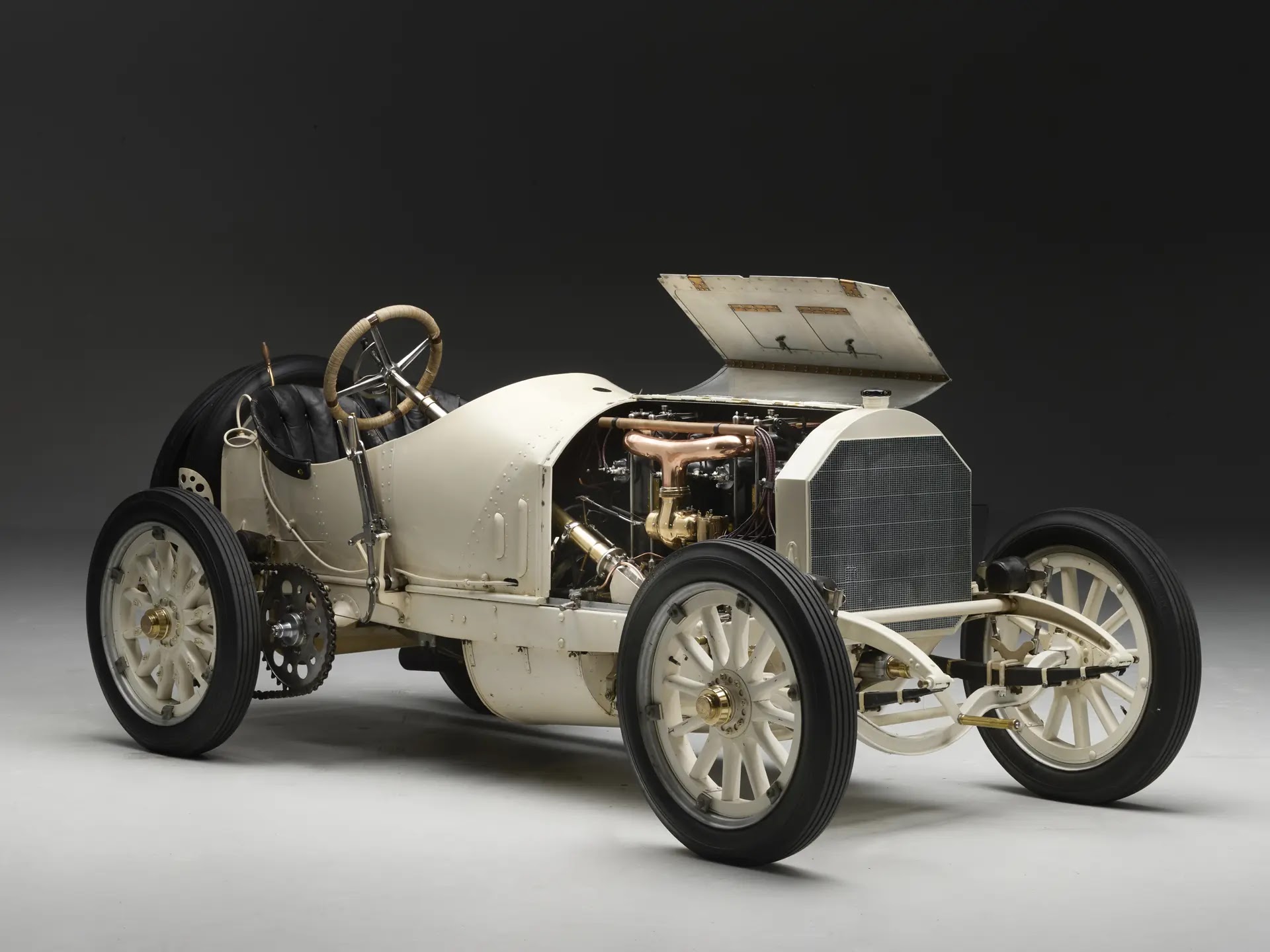
Mercedes 17.3-Liter 150 HP "Brookland" Semmering Rennwagen 1908, Alemanha
Fotografia
In 1906, Mercedes developed a new competition model, soon to become known as the “Brookland” after its accomplishments at England’s Brooklands, famously the first purpose-built automobile racing circuit. During the Brooklands circuit’s first year of existence in 1907, examples of the Mercedes achieved record speeds of 88.8 mph in the standing 10-mile run and 95.5 mph over a flying half-mile. Four years later another “Brookland” automobile lapped its namesake track at an average of 109 mph, setting yet another record.
Documentation from Daimler-Benz on file, received by a prior owner in 1948, indicates that this particular Mercedes was built under kommission number 5871 and workshop order 336, dated 16 June 1908, as a 1908 model “Brookland” chassis with a four-cylinder engine of 175-by-180 millimeter displacement. With this larger engine—actually larger than was legal for Grands Prix of the era—it was described as a “one only” car, purpose-built for and entered into the Semmering Hill Climb in Austria. This was one of the most prestigious competition events on the European continent at the time, a no-limits, proto-Group B clash of the titans with essentially no rules. Driven by Otto Salzer, this car claimed victory at Semmering, while achieving a new record speed for the event of 81.2 km/h.
Daimler-Benz correspondence notes that later in July 1908, the car was returned to the factory and outfitted with a new, much stronger motor, number 820, of 150 PS or 150 horsepower, produced from an utterly enormous 17.3 liters—such size that the engine was nearly visible from the front of the car, emerging in almost menacing fashion out of the front cross member! It was a unique engine, the only one of its kind ever produced, and while a big, blunt hammer, it served its purpose well.
Salzer drove the car under its own power to the Semmering event in September 1909. There, the defending victor again claimed the Semmering prize, in 7 minutes and 7 seconds at an average of 84.3 km/h, a record that stood for 15 years. Factory correspondence indicates that the following month, in October 1909, the car achieved 3rd against tremendous competition in the Champion du Monde at the Tervuren near Brussels, driven by Camille Jenatzy, “The Red Devil.”
Following this event, the car was outfitted with larger Michelin tires on “stock” rims, and sold to Milnes-Daimler Ltd. of London, England. Per factory correspondence, they delivered it on 7 December 1909 to Bennet & Wood of Covent Gosford Street, from which the car was exported to a buyer in Sydney, Australia.
The buyer in question was Lebbeus Hordern, who, as historian Bob King noted, “was just 18 years of age when his merchant father died, leaving him a ₤4,000,000 fortune. What better way to spend it than on the ultimate bird puller?” The Hordern family, proprietors of Australia’s leading department store, carried in its ranks many enthusiasts, with various arms of the family tree possessing many of the great European Brass Era automobiles. Young Hordern is not known to have competed with his new toy, but its next owner, his fellow millionaire Colin Smith, drove it in 1911 at Artillery Hill, south of Sydney. He then sold it to Percy Cornwell, a pottery owner in the Melbourne suburb of Brunswick, who both raced it himself and entrusted it to the hands of Rupert Jeffkins.
Cornwell eventually sold the Mercedes to Ike Watson of Melbourne, who appears to have removed the original seats. In this form the car survived until January 1942, when it was purchased by young Lyndon Duckett and returned to life, with the fitment of metal seats appropriated from an aircraft. In this form the car was pictured in a line drawing by Bob Shepherd in the July 1947 issue of Australian Motor Sport. King noted wryly that “in July 1953 at Fisherman’s Bend race track, the Melbourne Mercedes dealer attracted some attention, which they may have preferred to have avoided. They pitted their new 300 model against the 1908 car, and to the delight of the considerable crowd, it was soundly beaten.” King commented that the last time he saw the car was at a veteran car rally in Argus in January 1955.
That year, based upon the dates of California registration slips on file, the Mercedes was purchased by David Gray Jr. of Santa Barbara, California. Mr. Gray was the heir to a major early investor in the Ford Motor Company, and a noted sportsman who was one of the earliest collectors of “horseless carriages” on the West Coast, a contemporary of the legendary likes of Bill Harrah and Lindley Bothwell—both of whom would eventually acquire very significant cars from the Gray stable.
Mr. Gray retained the Mercedes until November 1964, when it was sold to Tony Hulman for the Indianapolis Motor Speedway Museum at the then-enormous cost of $30,000. There it has resided for the past 60 years, occasionally venturing out for events at the Speedway as well as elsewhere. In 2001 it was one of several significant automobiles that ventured from the Museum to England for display at the Goodwood Festival of Speed, and in 2023 it was an exhibition entrant in the feature Vanderbilt Cup Era Race Cars class at the Pebble Beach Concours d’Elegance.
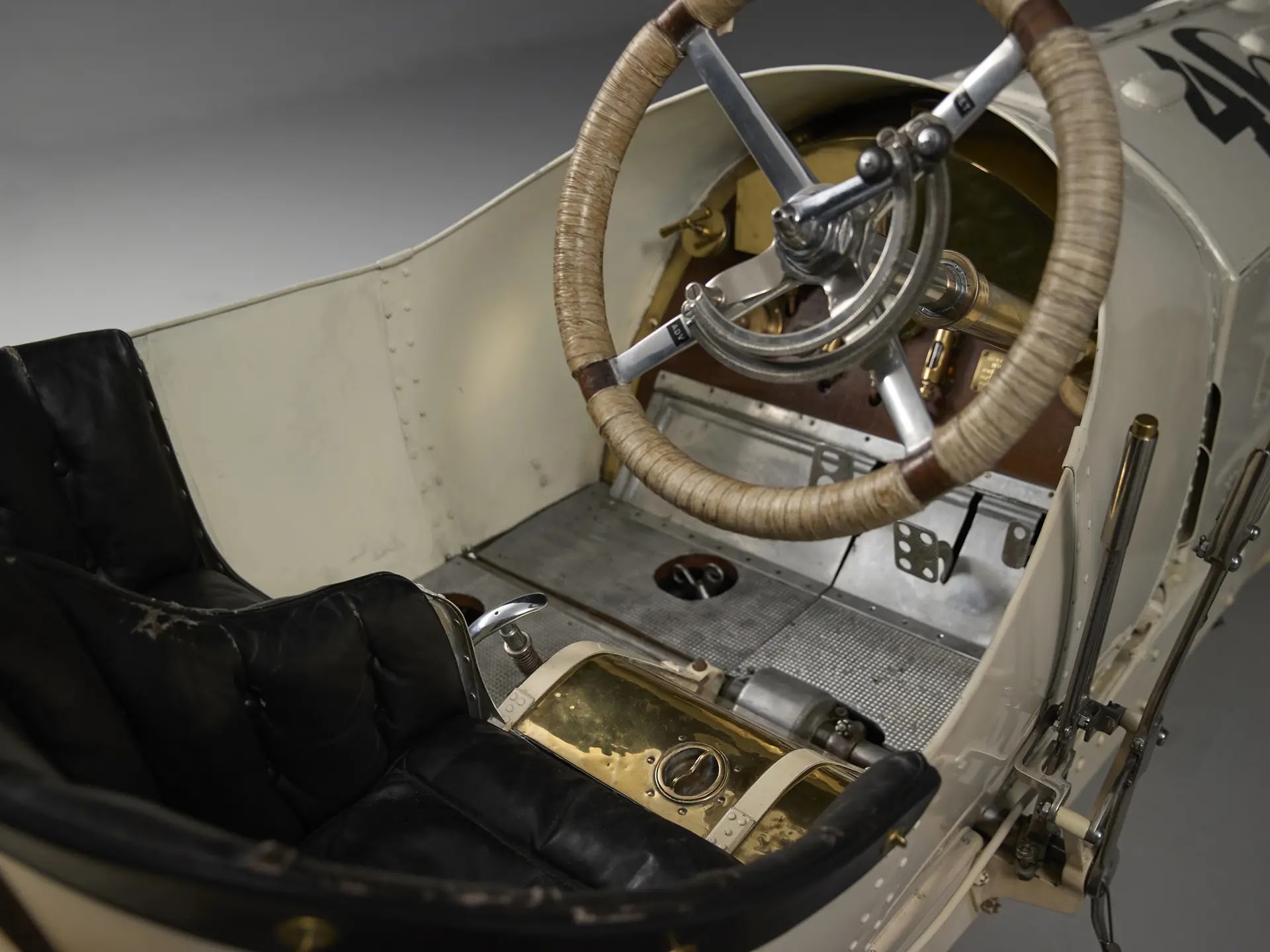
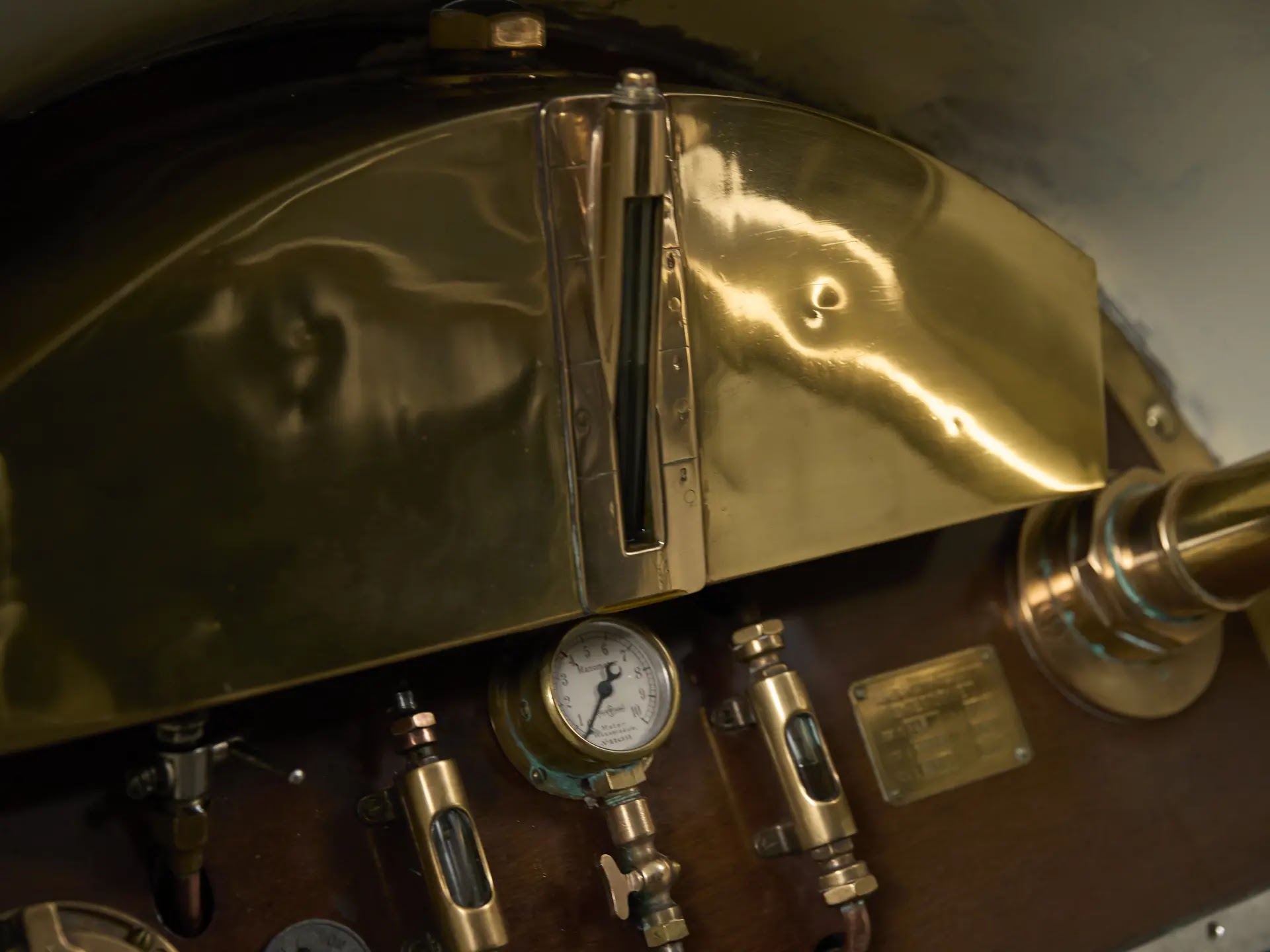
Recently mechanically recommissioned in preparation for sale, it starts easily, unleashes utterly outstanding power, and is a fantastically remarkable machine to drive. Most significantly, it boasts utterly incredible originality, including the original numbered radiator and carburetor, what is believed to be the original external exhaust system, the original gauges, remains of factory paint on the inside of the frame, and a transaxle case stamped “S,” perhaps for Semmering, with all the castings remaining in good undamaged condition. Significantly the car still has its original identification tag, which has remained with it for all these many years—unheard-of in a vintage competition Mercedes. Even the cylinders are individually dated!
This well-known works racer epitomizes the pinnacle of chain-drive, large-displacement Grand Prix and competition cars, with Mercedes being the most advanced and successful of the era—and, indeed, this represents the ultimate, most potent, one-off development of the original Mercedes design, one that produced a remarkable leap in performance that established its maker as a force to be reckoned with, on road or track.
In one of the letters documenting the history of this example, Daimler-Benz’s Marcus Clary summarily commented that “the Mercedes-Brookland, which was already developed in 1906, was extraordinarily successful beginning from 1907. She first had an engine of 80 and later of 120, 150, and more HP. Even in 1913, she was still triumphant.”
She still is. Texto da RM Sotheby's.
Nota do blog: Data e autoria das imagens não obtidas.
.jpg)


.jpg)
.jpg)
.jpg)
.jpg)
.jpg)
.jpg)
.jpg)
.jpg)
.jpg)



.webp)
.webp)


.webp)
.webp)





.webp)
.webp)
.webp)
.jpg)
.jpg)